
The day I inherited my late father's garden notebook, I sat down at his old kitchen table and read every word — twice. He wasn't much for long goodbyes, my father, but he filled those margins with more affection than thirty years of handshakes could hold. Mostly it was drawings of tomato root systems, star charts for planting schedules, and a recurring three-word phrase that appeared at least a dozen times: Epsom salt works. I laughed out loud. Then I went outside, looked at my pale, sorry-looking tomato plants, and thought: one more experiment can't hurt.
From Chalk Dust to Tomato Rows
I spent thirty years teaching high school chemistry in San Antonio — stoichiometry, titrations, the periodic table, all of it. I loved every bit of it. But there's a certain kind of learning that only happens when you're kneeling in the dirt at six in the morning, trying to figure out why your Roma tomatoes look like they've given up on life. When I retired and bought a half-acre in the Texas Hill Country, I thought I'd have a head start. Chemistry is chemistry, right? What I didn't expect was how thoroughly a tomato patch would humble a man with a chemistry degree.
I grow tomatoes the way I used to run lab experiments: methodically, obsessively, with a notebook in my pocket and strong opinions about the data. I've got ten varieties going at any given time — San Marzanos, Cherokee Purples, a few Brandywines my neighbor Elena gifted me, and a stubbornly excellent Yellow Pear that I cannot take credit for. I talk to them while I work. My neighbors have opinions about this. I have opinions about my neighbors' tomatoes, so we're even.
The Summer My Plants Told Me They Were Hungry
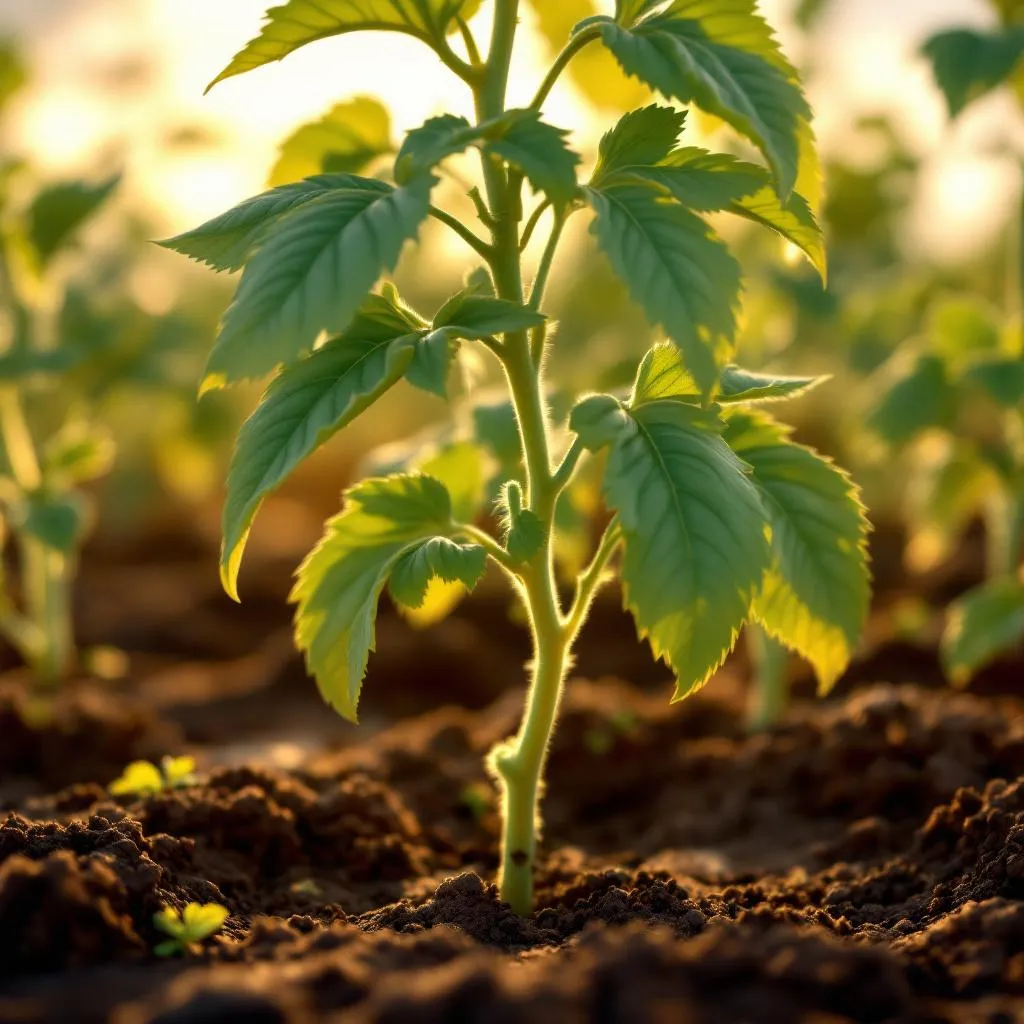
That first summer in the Hill Country, I noticed something wrong about six weeks in. My lower tomato leaves were turning yellow — but not evenly. The veins stayed stubbornly green while the tissue between them went pale and washed-out. I'd seen that pattern in a plant biology textbook once, years ago. Interveinal chlorosis. My tomatoes were magnesium deficient.
Here's the embarrassing part: I'd been so focused on nitrogen, phosphorus, and potassium — the big three nutrients splashed across every bag of fertilizer — that I'd completely overlooked magnesium. And magnesium, it turns out, is the mineral that makes chlorophyll actually function. It's the central atom in every chlorophyll molecule your plant produces. Without it, photosynthesis slows, sputters, and eventually stops. My plants weren't lazy or dramatic. They were starving for something I'd failed to give them.
That's when I went back to my father's notebook. And there it was, in his careful block print: Epsom salt — one tablespoon per gallon, foliar spray, every two weeks starting June. Don't forget or they'll tell you. Thirty years of chemistry education, and the answer had been sitting in a dead man's notebook the whole time. I was not laughing anymore.
What Epsom Salt Actually Does to Your Tomatoes
Epsom salt is magnesium sulfate. That's the whole secret — it's not magic, it's a mineral compound that dissolves cleanly in water and delivers two things your tomato plants genuinely need: magnesium and sulfur. I know what you're thinking. You're thinking: Sal, I don't have a chemistry degree, can you just tell me what it does? Fair enough. Here's the plain version.
Magnesium is what keeps your tomato leaves green. Every green cell in your plant contains chlorophyll — and chlorophyll is built around a magnesium atom the way a wheel is built around a hub. Pull out the magnesium and the whole structure collapses. No chlorophyll, no photosynthesis. No photosynthesis, no energy. No energy, no tomatoes. It really is that simple. Sulfur, the other half of Epsom salt, helps your plant build proteins and enzymes, strengthen cell walls, and absorb other nutrients more efficiently. Think of sulfur as the dependable lab partner who makes everything else in the room work better.
- → Greener leaves: Magnesium restores chlorophyll production, reversing that telltale interveinal yellowing — usually within ten to fourteen days of the first application
- → More fruit set: Adequate magnesium helps plants complete the energy cycle needed to develop and hold onto fruit — fewer flowers dropping before they set
- → Better nutrient uptake: Sulfur supports the enzymes that move other minerals — nitrogen, phosphorus, potassium — into your plant's cells more efficiently
- → Stronger roots: Both magnesium and sulfur contribute to root cell integrity, helping plants anchor and feed more effectively in sandy or depleted soils
- → Richer flavor: Many growers, including yours truly, swear that mineral-balanced tomatoes taste more complex and deeply savory — I'll admit this one is harder to measure in a lab, but I trust my data
Quick Deficiency Check
Look at your lower, older leaves first. If you see yellowing between the veins while the veins themselves stay green, that's classic magnesium deficiency. Upper leaves yellowing all over? That points more to nitrogen. The location and pattern of the yellowing tells you most of what you need to know before you ever touch a soil test kit.
A Tuesday Morning in My Tomato Rows
By mid-July, my half-acre has a rhythm to it. I'm up before six — partly because of the Texas heat, partly because that's when the tomatoes are most honest about how they're doing. I walk the rows with my coffee and my father's notebook, and if it's a spray week, I've got my two-gallon sprayer already mixed: two tablespoons of Epsom salt dissolved in warm water, applied to the leaves in the cool of the morning at roughly one gallon per foot of plant height.
I won't pretend there isn't something a little ceremonial about it. My neighbor Elena — who grows the finest serrano peppers in two counties — calls it my 'tomato church.' She's not entirely wrong. I narrate while I spray. Mostly it's chemistry: 'You're going to love this. Magnesium sulfate, highly bioavailable, give it about ten days.' Elena says that's the nerdiest thing she has ever seen in an actual garden. I tell her to wait until August, when I bring the first Cherokee Purples to the co-op. Then we'll see who has opinions.
"My father used to say that a garden teaches you more chemistry than any classroom ever could. He was right. It just took me thirty years and a half-acre of tomatoes to figure that out."
— Salvador 'Sal' Mendez, Texas Hill Country
Why the Co-op Takes Mineral Gardening Seriously
When I bring my harvest to the co-op, I'm not just dropping off tomatoes. Every crate connects to something larger — our harvests support real non-profit sustainable farms doing meaningful work growing and donating food in their communities. That matters to me deeply. It means I want my methods to be genuinely good for the land, not just good for this year's yield.
Epsom salt fits that ethic well. It's a naturally occurring mineral, mined from hydrated magnesium sulfate deposits found around the world — the name literally comes from a market town in Surrey, England, where mineral-rich springs were discovered centuries ago. Used correctly, it doesn't accumulate to toxic levels in the soil the way some synthetic fertilizers can. It addresses a specific deficiency without disrupting the broader soil ecosystem. That's the kind of targeted, restorative practice the co-op's partner farms have built their whole model around: give the land what it needs, nothing more.
- → Safe for soil life: Epsom salt doesn't harm the beneficial bacteria and fungi that keep healthy soil alive — organisms that sustainable farms depend on to do everything
- → Fills a specific gap: Sandy or heavily amended soils often leach magnesium quickly; a targeted application corrects the deficiency without loading the soil with excess minerals
- → Compatible with organic growing: Epsom salt is a naturally mined mineral, compatible with certified organic practices when used appropriately and in correct amounts
- → Builds plant resilience: Magnesium-sufficient plants handle heat and drought stress considerably better — which matters enormously when you're farming through a Texas summer
- → Reduces crop waste: Healthier plants set fruit more consistently, which means better yields and less of the harvest lost before it ever makes it to the co-op
Where Good Gardeners Go Wrong
Now I have to be honest with you, because thirty years in a classroom taught me that honesty is more useful than enthusiasm. Epsom salt is a real solution to a real problem — but it is not a cure-all, and I have watched well-meaning gardeners make every one of these mistakes, including myself in that first Hill Country summer.
- → Using it when there's no deficiency: If your soil already has adequate magnesium, adding more can throw off the calcium-to-magnesium ratio — which leads directly to blossom-end rot in tomatoes. Test your soil first.
- → Spraying too often: Foliar application is fast-acting, but more than every two weeks is overdoing it. Salt stress is real, and it's worse in hot weather when leaves are already working hard.
- → Applying to dry, stressed plants: Always water thoroughly before you spray. A thirsty plant absorbs minerals poorly and is more vulnerable to leaf burn from a concentrated solution on a warm day.
- → Skipping the soil test: Epsom salt solves one specific problem. A basic soil test runs about fifteen dollars and tells you what's actually happening across all your nutrients — do that first, then decide what you need.
- → Expecting overnight results: Foliar application takes seven to fourteen days to show visible improvement in leaf color. I have seen people spray once, see no miracle by the weekend, and quit. The plant is working. Give it time.
Sal's Two Rules
I never break these: one tablespoon per gallon for foliar spray — anything stronger and you risk leaf burn, especially in summer heat — and spray in the morning, never midday or late afternoon. Wet leaves baking in Texas afternoon sun is a reliable way to damage plants you've worked hard to grow. Morning spray gives the solution time to absorb before temperatures climb, and your plants will thank you for it.
Here's the thing nobody warned me about when I traded the classroom for the garden: it's relentlessly humbling. I had a degree, thirty years of experience, and the quiet confidence of a man who once explained electron orbitals to a room full of skeptical teenagers. And a half-acre of tomatoes still sent me back to my father's handwriting, hat in hand, looking for answers he'd already worked out decades before I started asking questions.
Which is exactly how it should be. He didn't have a chemistry degree. He had decades of watching, adjusting, and paying close attention to what the plants were telling him. He had margin notes in a worn spiral notebook and, according to everyone who ever tasted them, the most remarkable San Marzanos in the county. I would trade a good portion of what I know for having learned it his way from the beginning.
If your tomatoes are looking a little pale and tired this season, I hope this gives you somewhere useful to start. Mix up your Epsom salt solution properly — one tablespoon per gallon, warm water — spray it on a cool morning, and check back in ten days. Talk to your plants while you're at it, if you're inclined. They won't judge you. And if your harvest ends up at a co-op that turns it into something real and good for someone else who needed it? Well. That's a pretty fine reason to keep going out there every Tuesday.